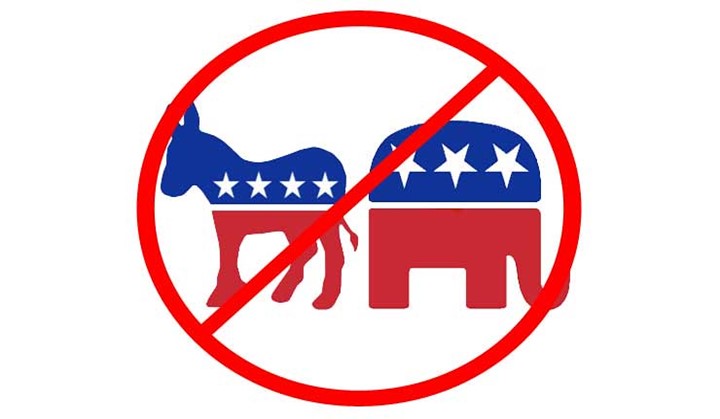
I will presume you have some information about the two-party system. In simple, this means only two major parties receive a majority vote for the representatives. It further shows that only one of the two parties can win the majority in the government. A good example of two-party systems is the US.
A two-party system has its pros and cons. For that reason, we have shared a list of ten pros and ten cons to leaving you well informed.
**Pros of the two-party system **
1**. It simplifies the election process-**A two-party system makes the whole voting process easier and fast. A voter will check the handful of issues that are important to them and eventually cast their vote accordingly.
2**. The system eliminates confusion**-in countries where people deal with many parties during the election period; it’s easy to be confused. People face challenges cramming all the parties. They can confusingly vote for the wrong party.
3**. The common ideas gain traction**-There will always be a partisan idea in a two-party system. This idea will be promoted by the majority and conflicted by the minority. This idea makes it hard for parties to practice extremism.
4**. More people participate in the civic process**-In governments where there are multiple parties, it creates multiple platforms that should be evaluated. This shows that without the two-party system, someone can easily come up with his or her parties.
5**. It speeds up the process of governing**-in the case of emergencies, a two-party government can easily respond to the issues. This is simply because all branches of the government will participate in the two-party system.
6**. Anyone can run for office**-The The two-party system gives any person regardless of their status a chance to run for office. This is actually what promotes the most experienced to win the majority vote.
7**. It encourages the majority representation**-The party that gets to the governance represents the will of the majority. This is because the voters represent the number of people satisfied with the governance.
8**. People with extreme views cannot be elected**-This kind of governance makes it hard for people with extreme views to be elected into office. The two-party system also restricts the concept of going overboard in an elected office.
9**. Reduces the cost of the Electoral board**- In case of more than two parties, there are chances for a rerun. In this case, the electoral board will reduce the cost of facilitating different parties and setting aside funds for a rerun.
10**. The governing process is easy and fast when** there are fewer parties involved, the government can easily govern the people without giving ways for wastage of time from the opposition and other parties.
**Cons of two-party systems **
1. The inconsistent governing patterns-One distinctive disadvantage of two-party systems is that they may end up creating inconsistent governing patterns. This is not the case with a coalition government where there’s consistency in governing.
2**. Not 100% representation of personal idea**- this is definitely because the two-party system puts multiple offshoots beneath on the general umbrella.
3**. The party is changed into a fixed but changing set of political views there’s** an idea of a set of a listing priority that every person will want to accomplish in this kind of governance.
4**. The number of ideas will be limited**-Now because there are only two parties involved; all the other parties with ideas will be limited. This is one big challenge because as we know, the best ideas live with the minorities.
5**. It creates a system of exclusivity**-some states in a country that will only go for specific parties regardless of how bad their governance ideas are. In the case you vie with a different party in such states, you will be put down no matter how good your governance seems to be.
6**. It reduces the choices of the voter**-Voters who have fewer options when it comes to voting. They will only have to choose the democrats or the republicans.
7**. The voting patterns are based on the name recognition-**This kind of governance creates a pattern where people will go for prominent names rather than ideas.
8**. It may lead to societal polarization**-This is an idea that was put forth by P.J. O’Rourke. It is a very serious disadvantage that polarizes some societies.
9**. It introduces a pluralist system**-An example of the US, more than 90 percent of the states are given the votes on a basis this or nothing basis. This means that this form of government limits the chances of a 3rd party with a candidate that can be recognized.
10**. It limits debate**-when you listen to ideas from only two people, then there’s the limitation of ideas and other important views that could help the country.