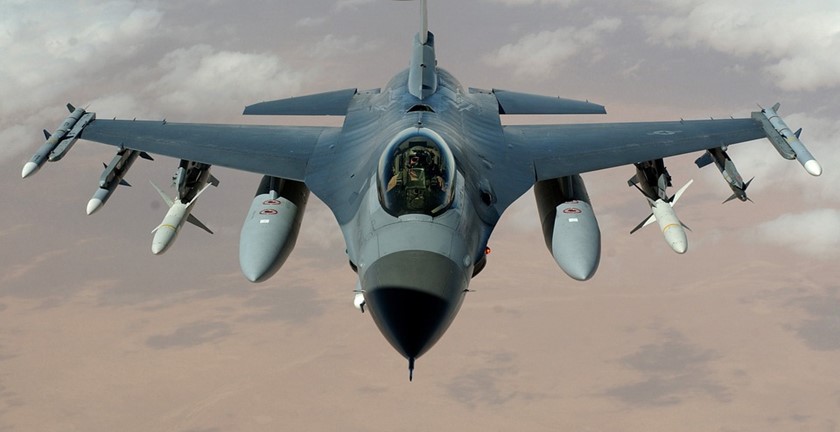
F-16 is a US lightweight fighter falcon used in carrying an array of missions. Over the years, the F-16 jet has evolved into a versatile air-to-ground aircraft, extremely maneuverable, and supports battlefield air interdiction.
It is one of the respected and feared aircraft that carry out precision-guided missiles, and other air defense suppression missions. This article guides you on the benefits of using F-16 on the battlefield and its drawback.
Pros:
**1. Lightweight: **F-16 fighting falcon was the first lightweight jet designed to provide greater performance at low altitude.
**2. Better agility: **The fighting falcon can easily compete with the latest Su-30 and Su-35 jets thus making them more effective in long range battles.
3. Weapons load capacity: F-16 has a large weapon load capacity with an internal volume capacity. The multitude uses of internal upgrades depends on the available internal volume. The jet can carry AIM-9, AGM-88, and small bombs.** **
4. Cost-effective: Compared to other fighting jets, F-16 is one of the medium priced jets with low maintenance cost. The aircraft was designed to ease the maintenance and movements.
**5. Flight-by-wire control system: **F-16 fighter jet has a fly-by-fly-wire system that keeps the jet pointed to the direction the pilot wants it to go. This makes it highly maneuverable.
**6. Onboard flight controls: **The Fighting Falcon has onboard flight control computer which enhances the stability of the aircraft. No constant input from the pilot is required especially when maneuvering is commanded.
**7. Performance: The Jets have customized performance with an effective and accurate night lighting. The aircraft have increased airframe life compared to other aircraft. **
**8. Superior acceleration: F-16 fighting aircraft has superior acceleration and is one of the fighting jets with high climb rate, endurance, and superior turn rates compared to others. **
**9. Prevent energy loss: The falcon fighter is aerodynamically designed to help reduce energy loss when the aircraft maneuvers at low attitudes. **
10. Maneuverability: It also has superior maneuver performance to handle transonic and subsonic speeds. The maneuverability of the aircraft is achieved via fly-by-fly wire control system.
Cons:
**1. Control issues: During bad weather conditions, the pilot may experience problems with the control systems especially when struck by lightning. **
**2. Single engine: **The flight falcon uses a single engine resulting in OEI problems. This makes it more vulnerable to failure making it less powerful.
**3. Slow: compared to F-15 aircraft, F-16 fly at low speeds and cannot fly at high altitudes. **Although it is easy to maneuver a single-engine fighter, it is not the fastest.
4. Poor vision: It has a lower polygon count that reduces the actual visual quality of the aircraft on the rear sides making them have poor vision. ** **
**5. Size. **Due to its small and lightweight design, F-16 aircraft cannot lift huge bombs. The aircraft has higher thrust-to-weight ratio giving them the ability to live few bomb components.
**6. **Poor FPS: F-16 uses high-resolution 2D gauge which makes some systems experience poor FPS prior to the release of performance manager.
**7. Small lifting surface: The aircraft utilizes vortex lift at high angles of attack thus, the fuselage creates a small lifting surface. **
**8. Obsolete: Advancement in technology has little room for modification making F-16 obsolete. Although you can upgrade the aircraft, more modern fighting aircraft are being established in the market. **
**9. Inferior sensor technology: The F-16 aircraft has inferior sensor technology presenting a strategic disadvantage when competing with more advanced aircraft. **
**10. Radar system upgrades: **Upgrading the new falcon fighter with the latest and effective radar system adds to the maintenance cost of the aircraft.